

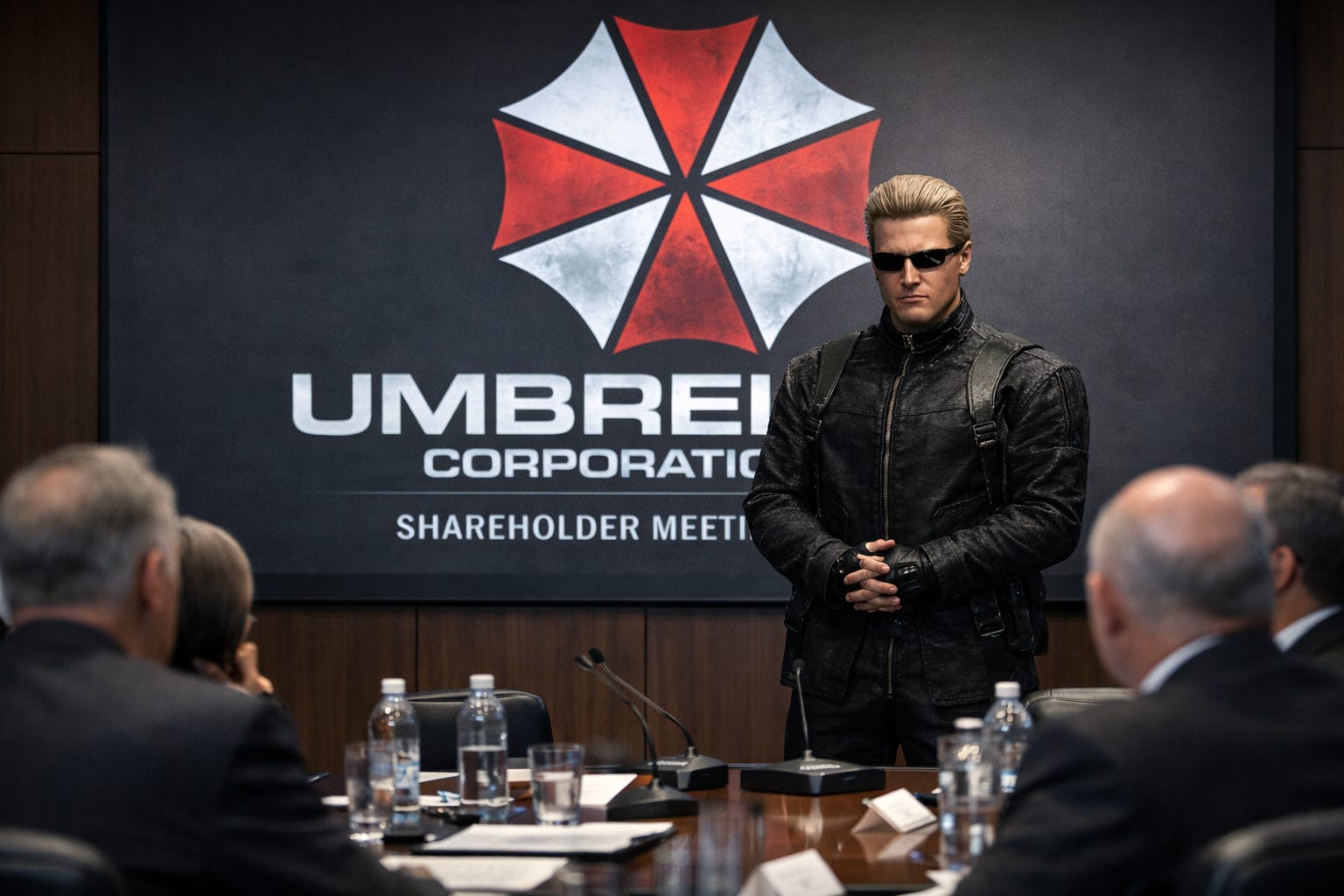
Ninety-three-year-old Lord Ozwell E. Spencer wheeled himself to the center of the dais.
“Thank you all for attending the Umbrella Corporation quarterly shareholder meeting. Before we open the floor, I want to introduce the rest of today’s panel. To my left, Dr. William Birkin, Chief Science Officer.”
“I’m Dr. Kevin Morse,” the man corrected.
Spencer looked confused. “What happened to Birkin?”
“He mutated and was blown up,” Morse explained.
Spencer nodded. “Oh. Right. Anyway, to my right is Albert Wesker, Vice President of... Albert, remind me of your current title.”
Wesker adjusted his sunglasses — indoors, as usual. “Vice President of Strategic Bioweapon Applications and Forward-Facing Lethality Solutions.”
“A very important position,” Spencer said. “Now, on business, Q3 was a period of strategic repositioning for the company—”
“You got Raccoon City nuked,” said a man in the third row.
“As I said. Strategic repositioning.”
The man stood up. His lanyard read GERALD HENDRICKS — SERIES B INVESTOR. “I’ve been a shareholder for six years. When I invested, you pitched me on pharmaceuticals. The company is literally called Umbrella Pharmaceuticals. You showed me a slide deck about cancer research.”
“We remain deeply committed to the pharmaceutical space.”
“You made a giant snake.”
Spencer glanced at Morse. Morse studied his notes intensely.
“That was exploratory R&D,” Spencer said.
“It was a snake! A snake the size of a gymnasium. What’s the TAM on giant snakes? Who’s the customer? What’s the use case?”
A woman near the front raised her hand. “Karen Liu, pension fund manager. I have a similar concern. My analysts tell me you have a product called a ‘Licker.’ Can someone explain to me what a Licker does?”
Morse leaned into his microphone. “The Licker is a highly advanced bioorganic weapon with a prehensile tongue capable of—”
“So it licks people.”
“It’s more nuanced than that. We’re talking combat capable—”
“Combat? How is a Licker better than, like, a gun?” Liu asked.
“It’s intelligent and can seek out and destroy enemies on its own,” Morse explained.
“Does it follow orders?”
Morse hesitated. “Not... currently.”
Hendricks was still standing. “I want to go back to the Raccoon City issue. An entire American city is just gone. It’s a smoking crater. How is that not a material liability?”
Wesker leaned into his microphone. “We view Raccoon City as a proof of concept of the T-Virus’s effectiveness in a live environment.”
“And what’s the T-Virus again?”
“It’s the next step in human evolution,” Wesker stated. “It—”
“It turns people into zombies, right?” Liu asked.
“Yes, as a side effect, but—”
“We’ve had multiple zombie outbreaks — nearly threatening to end the world in a zombie apocalypse!” Hendricks said. “How does that help shareholder value?”
Spencer cleared his throat. “What Wesker is trying to convey is that the Raccoon City incident, while regrettable, generated invaluable field data—”
“I don’t want field data. I want a return on investment,” Hendricks said. “I could have put my money in Johnson & Johnson. You know what Johnson & Johnson has never done? Had a zombie outbreak destroy a city. Not once.”
A murmur of agreement rippled through the room.
Liu jumped back in. “I also want to flag the employee retention issue. Your attrition rate is — and I need someone to confirm this for me because I thought it was a typo — four hundred percent annually? Why do people keep leaving your company?”
“People like working for us,” Wesker stated. “It’s seldom that people leave. It’s more... being eaten.”
“Is that better?” Liu asked.
“I think it shows that people enjoy our innovative research so much, they willingly take on the risk of being eaten,” Spencer said.
A new voice piped up from the back. “Ted Morrison, retail investor. Quick question: Why so many underground labs? I’m counting seven different ones. That seems like huge unnecessary expenses to dig out these underground labs instead of traditional buildings on top of the ground, as Pfizer would have.”
“It’s a safety concern,” Morse said.
“Because everything you make turns against you,” Hendricks stated. “Which gets back to the central problem!”
“Not everything,” Wesker said, “The Nemesis program showed significant improvements in target acquisition and elimination.”
“Didn’t it try and fail to eliminate one woman in a tube top?” Liu asked. “How is that anything nearing a success?”
“She was a very difficult target,” Wesker answered. “At one point, the Nemesis had her severely injured, but she got some green herbs to heal her injuries. In the future, we plan—”
“Wait, slow down a second,” Hendricks interrupted. “She healed injuries with a green herb? Like what kind of injuries?”
“Cuts, broken bones,” Wesker said. “I don’t see how that’s relevant.”
“You’re telling me there is a magic herb out there in Raccoon City that can heal any injury?” Hendricks asked with disbelief.
Wesker shrugged. “Apparently.”
“Why is that not your focus?!” Hendricks screamed.
“Yes, an herb that heals absolutely anything sounds way more profitable for a pharmaceutical company than tongue monsters!” Liu exclaimed. “You should forget these underground labs filled with dangerous failures and put your money into researching that.”
Spencer, Wesker, and Morse were quiet as they all considered this. Finally, Morse said, “If we injected the green herb with T-Virus, it could become large enough to overtake a city.”
Wesker nodded, and Spencer said, “Excellent idea!”
Hendricks sighed. “We need to elect a new board.”
Who names a city "Raccoon City" anyways? They deserved to get nuked, we all know it.
Tell me more about the woman in the tube top.